My Grandma Thinks Touch and Face ID Will be the Downfall of the US

Featured image by Steve Johnson on Unsplash

When I was in 5th grade, I received my very first piece of technology that was solely mine. It was a tiny slide phone that basically served the purpose of assuring my parents that I would not be kidnapped if they allowed me more independence outside of the house. In 6th grade I received an iPod touch 4, by 8th, I had my first iPhone. From that point on, my world was opened up to the everchanging world that is technology. It became something I relied on daily, hourly even.

My friends share similar experiences fo their introductions into technology like phones and computers. My housemates are twins and shared a flip phone from 4th grade to 8th grade. My best friend didn’t get her first phone until 7th grade, but she skipped the flip and slide phones and went straight into an iPhone. My age group of middle class people seemingly went through similar transition in their preteen years that greatly affected how we view and use technology as adults today.

We use our phones and computers for everything. We use our phones for communicating, playing games, getting directions, procuring food, and so much more. We use our laptops and iPads for schoolwork, photo editing, watching tv and movies, searching up mysterious medical symptoms, etc. The people close to me in age might share this similar experience, we grew up in the time when Apple product drops were bigger news than a moon landing.

But, what about the people younger than myself? Or the people older?

Multiple iPhone generation Photo by Tron Le on Unsplash, Two Computer Photo by Glenn Carstens-Peters on Unsplash, iPod Photo by Batu Gezer on Unsplash

To get a better perspective on the younger generation’s ties to technology, I spoke with my cousin and her daughter who is about to turn 12. Her name is Annabelle and she got her first phone in 1st grade. It was an iPhone and her mother theorized that the sudden drop in the age kids seem to get phones can be attributed to the abundance of the technology. My cousin gave her daughter her hand-me-down phone since she tends to get a new iPhone every 2 years. She also figured that it couldn’t hurt for her child to always be able to get in contact with her.

This is a trend I have noticed. Kids are getting younger and younger when they receive their own pieces of technology. They also are much more exposed to it in their earlier years. I was calling my best friend’s landline home number for playdates, nowadays, kids can just send their friends text messages.

There is also, obviously, an increase in the amount that technology is used in school. Some elementary students receive iPad’s that they can take home with them for the school year. Now we take university classes to learn how to utilize the technology in classrooms.

If this is a dramatic shift for me and people my age, you can only imagine how older generations feel about all this technology.

My grandma is a spunky lady. She asked us one year to gift her ‘cool’ socks because she wanted to ‘hip’ like my sister and I. We liked to wear patterned socks that never matched. However, hip she is not when it come to technology.

Photo by Marvin Meyer on Unsplash

Just this past weekend I had to help her through setting up her new phone over FaceTime. She expressed her disdain for setting up the facial ID that allows you to avoid putting your password in every time you open up your phone. This is something most people find pretty convenient. But my grandma, who is a self-made millionaire, thinks facial ID and Touch ID are efforts by the government to have more access to our private lives.

According to her, They are cataloging our faces and fingerprints, adding this information to a database that allows for easier tracking of US citizens. This speaks to her general distrust of all the emerging technology.

Her husband of 59 years, my grandpa, who passed away in January 2021, was a teacher for 50 years in a small town in southern Washington. I know both of them held strong opinions about the use of technology in schools. My grandpa often said technology had no place being so ingrained in the modern school system. But he also retired before it became commonplace to even have projectors set up in classrooms, especially in smaller towns. I think he would be able to see the positives of it had he had more hands-on use of technology. But this was also the guy who only ever owned a flip phone and never learned how to answer that, so maybe not…

Generationally, it is really interesting to examine the differences in thoughts on technology. Some people think we don’t utilize it enough, others think it is helping the government topple our freedoms. Whether you’re of one of these opinions or somewhere in the middle, I do believe technology is a great tool when tapped into correctly by teachers. The classroom should never revolve completely around tech, but it is impossible to ignore the prevalence it has in our lives and how even in the time since I was 10-year-old things have changed a lot.

The Rule of Thirds in Photography

Featured image by Clay Banks on Unsplash

An art lesson on the rule of thirds an intermediate elementary class.

First of all, what is the rule of thirds?

Also known as the “Golden Ratio”, the rule of thirds is a mathematical relationship of proportion that can found in our natural world. Mathematicians have studied this unique ratio for centuries, and artists and architects such as Salvador Dali, Le Corbusier, and Leonardo da Vinci have used it.
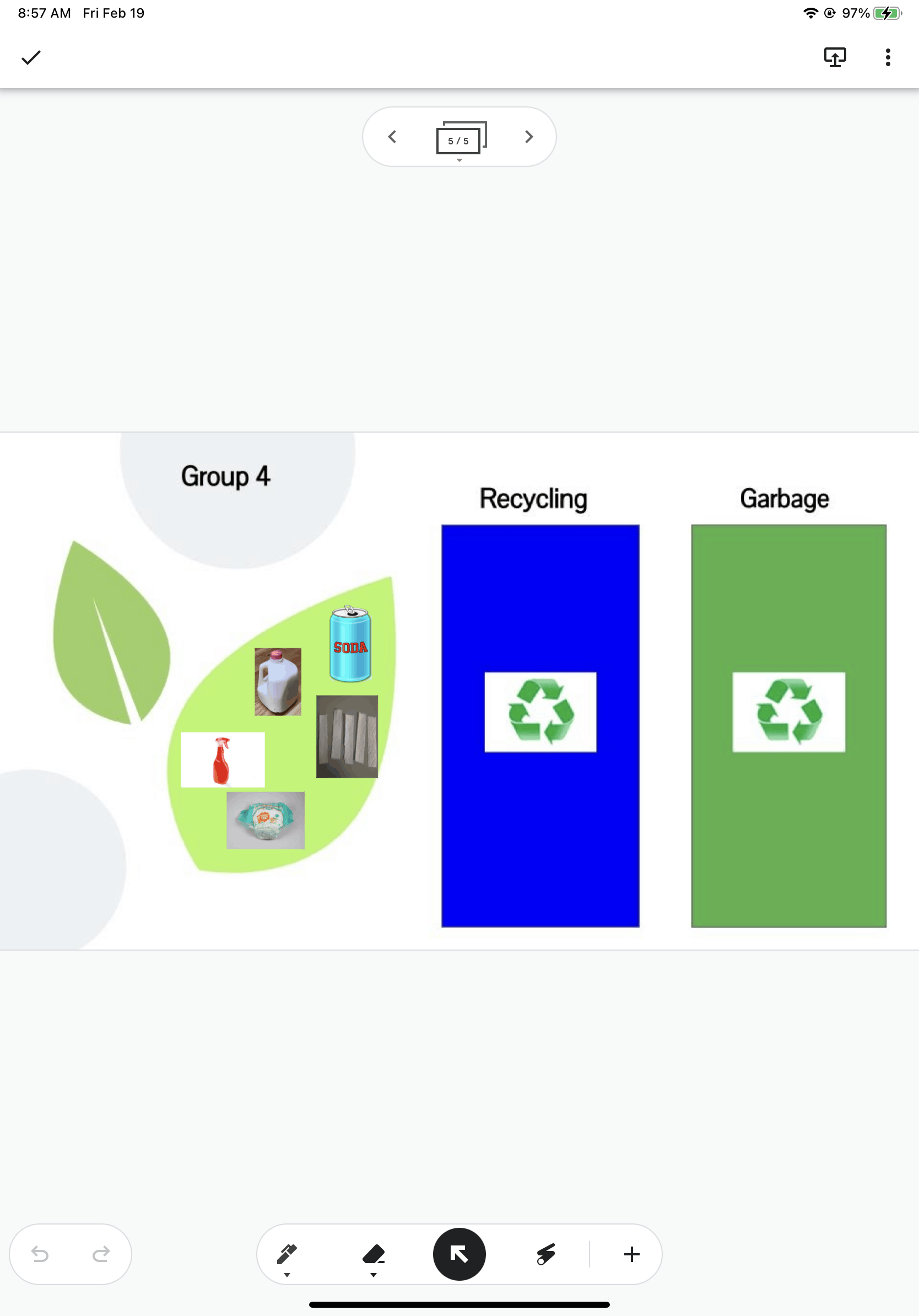
Photo by Jana Sabeth on Unsplash

What does the rule of thirds look like?

Imagine you’re playing tic tac toe with a friend. You draw the board as shown below. Two sets of parallel lines that intersect each other.


But instead of playing the X and O’s game, notice how the lines intersect one another at a third of the other line. Both the horizontal and vertical sections are split into three sections due to this intersecting. This is the grid that you can imagine upon for works that use the rule of thirds. Many photographers live by this rule, painters and other artists favor it as well.

Why is the rule of thirds important?

The rule of thirds, when used properly, has the ability to guide the viewer’s eyes to the best parts of the photograph. It is like an invisible highlighter. It also creates a sense of unbalance that makes the picture interesting to look at.

Personal Photograph from author taken in 2020 at Zion National Park

The rule of thirds as seen in photography…

Tree Photo by Gabriel Meinert on Unsplash, Waterfall Photo by Clay Banks on Unsplash, Mountain Photo by Burgess Milner on Unsplash, Beach swing Photo by Eyre June Bustamante on Unsplash

Comparing Fascism vs. Communism Jamboard Activity

Activity Context:

This activity uses Jamboard as a graphic organizer. I created a venn diagram for students to fill in with various traits of fascism and communism.

Target Student Group:

9th grade Modern World History students who are beginning a unit on WWII. This lesson is also designed for a virtual classroom during Comprehensive Distance Learning.

Instructions for Students:

  1. You will be split into 3 groups in breakout rooms.
  2. Each group will work on a different page of the Jamboard to drag and sort the “clues”  in the venn diagram and figure out the key similarities of fascism and communism.
    1. You can use these sites for reference in addtion to our class slides:
    2. https://www.britannica.com/topic/fascism 
    3. https://www.britannica.com/topic/communism 
  3. You will have 10 minutes to work.
  4. Be prepared to have 1 member explain how you sorted your clues. We will discuss each group’s findings as a whole class.

Goal for this Lesson:

Students will be able to define fascism and communism. Then, students will be able to compare and contrast key traits of fascism and communism by completing the venn diagram accurately.

Jamboard will help my students achieve this goal because it provides an easier platform for them to drag and drop the key traits in an online setting. If we were in person, I would cut out pieces of paper for my students to arrange in their respective circles in the venn diagram, but the challenges of online learning make this task more difficult to adapt to a group setting. Jamboard allows multiple students in a group to work on each page of the Jamboard and collaboratively arrange the traits. They will do this by dragging the sticky notes on the page to the correct circle, indicating that it is a trait of fascism, communism, or both.

The Jamboard Activity

Link to this activity on Jamboard

Group 1’s Page:

Group 2’s Page:

Group 3’s Page:

The Name is Lines…Time Lines…

This activity is designed for middle school or early high school level students learning about the American Revolution. This activity in particular follows discussions on the causes of the American Revolution and some background on the battles (for two of the activity options, the third does not necessarily require any background knowledge of the battles). The end goal of this activity is for students to build a timeline of important battles during the American Revolution.

This activity starts with a Braindump; this is an activity where students brainstorm about a topic they learned about recently. For this activity, students will leave post-its on causes for the war that they can remember from class discussions.

The Braindump allows for students to recall previous information and present it back to the teacher. It also allows for a refresher on causes of the war that some students may have forgotten. The Braindump can be modified to fit whatever the teacher may want their students to recall before this activity.

For timeline building, the Jamboard has three different ways a teacher could do it.

All three options can be done in a collaborative group setting. Duplicates can be made of the slides and students can work in pairs or larger groups to build timelines. The different options allows for more flexibility depending on the teacher’s curriculum schedule.

Image Citations:

Featured Image: Photo by airfocus on Unsplash

Jamboard Images: Photos by Sophia Winland

Jam board Activity: Daily Number

Good morning, kindergarteners! Like every class, we will be doing our daily number jam board! The link below is down below! Remember to go to the page number that is the same as your student number, for example, if you are student number 5, then skip over to find your page on slide number 5! *Show example*

https://jamboard.google.com/d/1DTGqxLa8G3cN6nGK3GXNXZAqFwjsa4FmzYEpqDQUn-w/edit?usp=sharing

Instructions:

  1. First, the teacher will roll the dice and our daily number will be the number of dots on our dice
  2. We will type out the number together and go through all of the different sections of the page in order to fill out the whole paper
  3. The teacher will then print out each person’s individual daily number and put it into each student’s prospective portfolio

Goals

  1. Get students comfortable with their numbers 1-6
  2. Develop different ways to create a number (Base 10 blocks, number line, counting fingers, tally marks, addition equations, coloring blocks, and addition webs)
  3. Get student’s brains going first thing in the morning

Photo by Robo Wunderkind on Unsplash

Come Jam with Me

Come Jam With Me

Ordering Numbers with Jamboard

Hi 7th grade mathematicians, today you are going to work in groups of 4 to complete the task. Your group will need the Jamboard slide assigned to you. On the Jamboard you will see a lot of numbers. Work with your group mates to order the numbers from least to greatest. Be careful, there are some absolute values that you need to pay attention to. Remember, the absolute value of a number is the distance it is away from zero.

The goal of this lesson is to help you practice ordering signed numbers. Remember that signed numbers include both positive and negative numbers. Make sure you pay attention to the sign when completing the activity.

There are many things in mathematics you need to order! Adapt this Jamboard to any ordering activity. This Jamboard could also be made into a homework assignment or an in-class warm up. This specific assignment is a group assignment because it allows for students to collaborate and combine their knowledge to complete the task. I have also adapted this activity to make it a pre and post assessment. I have my students attempt this before learning about ordering signed numbers and then complete again after they have learned about signed numbers with the same Jamboard. This allows for the students to see what they had preciously thought and to refine their thinking.

Warm-Up: Solving for the Unknown

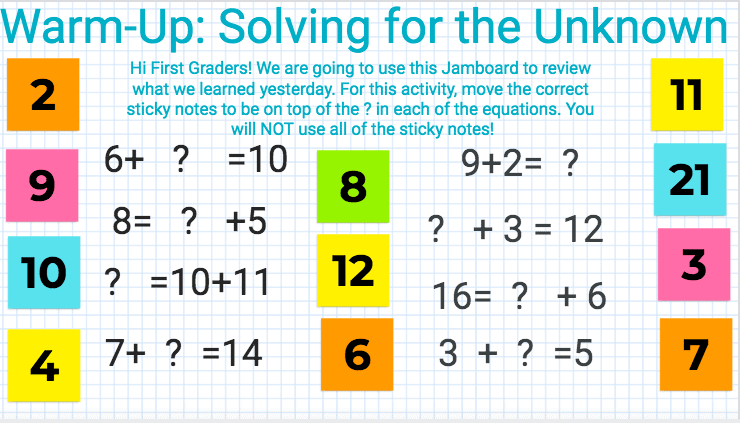
Hi First Graders! We are going to use this Jamboard to review what we learned yesterday. Every student should have received a link to their own personal Jamboard in their email before class. For this activity, move the correct sticky notes to be on top of the ? in each of the equations. Once you are done, privately message Ms. Carbary a number from 1-5 stating how confident you feel with your answers. (1 being not at all confident and 5 being super confident). You will NOT use all of the sticky notes! Create pictures on a scratch piece of paper to help you solve each problem.

https://jamboard.google.com/d/1rARQxDY2AL76XyMv58COpUIYJSWbkCQrVRYYhQbKVyc/edit?usp=sharing

Learning Targets:

  • I can solve for the unknown number in an equation by using drawings to represent my thinking.
  • I can explain why the order of whole numbers does not matter in an addition problem. (example: 6+3=3+6) by imagining if the question marks and the numbers switched places in the equation.

Goals From the Teachers Perspective

  • Inspired by the 1st grade Common Core Standards listed below.

CCSS.MATH.CONTENT.1.OA.D.8
Determine the unknown whole number in an addition or subtraction equation relating three whole numbers. For example, determine the unknown number that makes the equation true in each of the equations 8 + ? = 11, 5 = _ – 3, 6 + 6 = _.

CCSS.MATH.CONTENT.1.OA.B.3
Apply properties of operations as strategies to add and subtract.2 Examples: If 8 + 3 = 11 is known, then 3 + 8 = 11 is also known. 

  • This Jamboard activity gives students the chance to practice their skills and show their work by creating illustrations on a scratch piece of paper.
  • Students can easily move around the sticky notes to correct their thinking.
  • This format will also help understand that what they are solving for in a math problem can be anywhere in the equation, it does not have to be on one side of the equal sign each time.
  • This activity is a fun, easy, and environmentally friendly way for the teacher to understand where his/her/their students are at!
  • Once students are done, they are asked to express their comfort levels to the teachers, which is a great informal assessment for immediate feedback.

Geometry Proofs Using Jamboard

For my Jamboard activity I constructed an activity for students to work collaboratively to do proofs in geometry. This would probably be for a middle school or high school geometry class. I would categorize this as a graphic organizer activity.

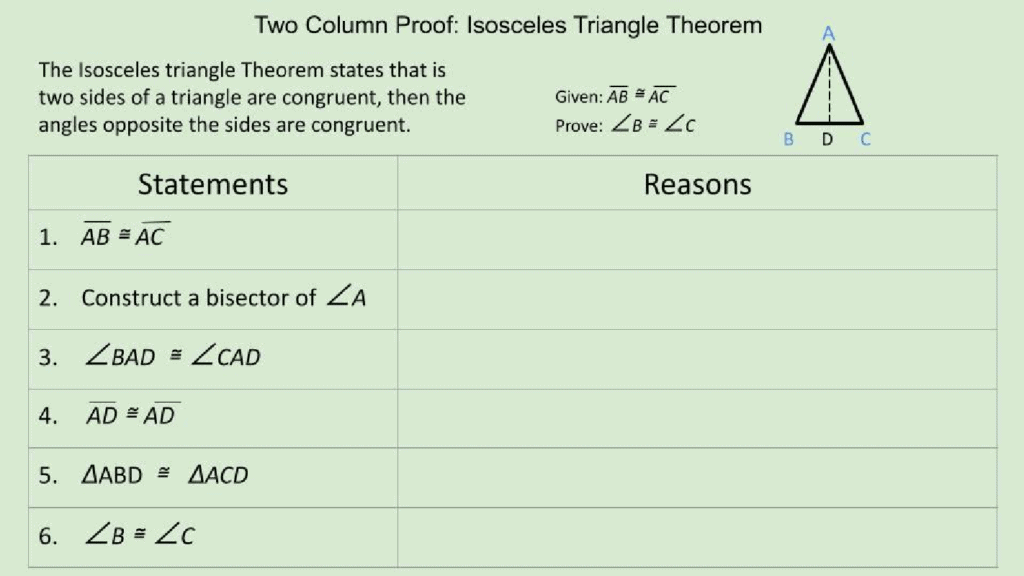
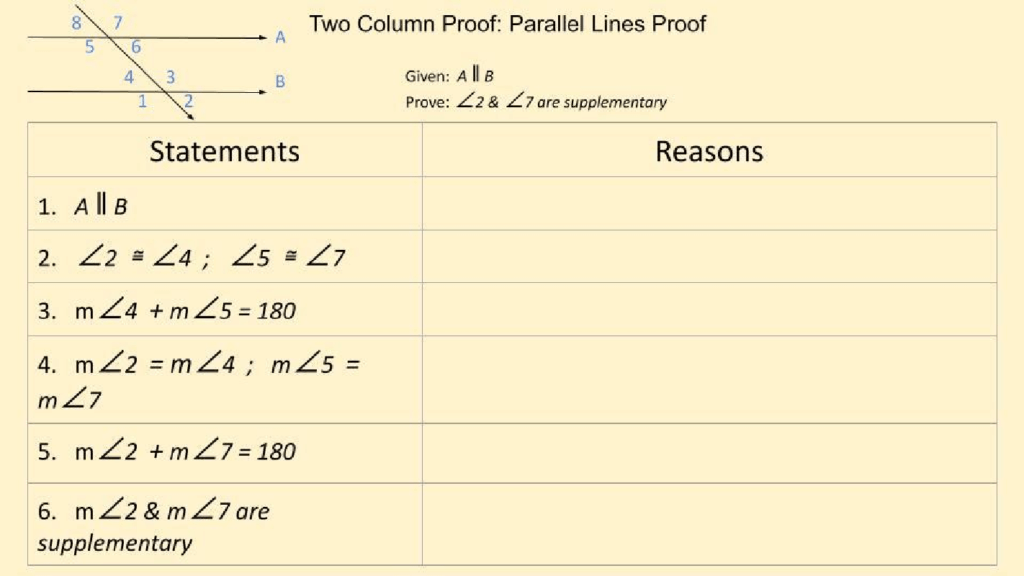
I created two proof tables in Google Draw that had all of the statements without any of the reasons. I would then divide up the students into groups and assign each group a slide. I would make more slides if I were actually using this in a classroom so that there would be 3-4 students per group. Using groups for this activity is helpful because if some students didn’t have the technology to access Jamboard, they would still be working on the problem with their group mates. Also working in groups means that there may be less than 20 students on the one Jamboard at the same time. They would work together to fill out the reasons column of the proof table using the text boxes or the post-it notes. If the students were online I would put them in breakout rooms with their group so they could talk. Once they were done, we would go over them in class.

The goal of this activity would be to help students identify what to use as their reasons when doing proofs. The proof is already started so they are focusing on just identifying the reasons for each statement, whether they are theorems, given, definitions, etc.

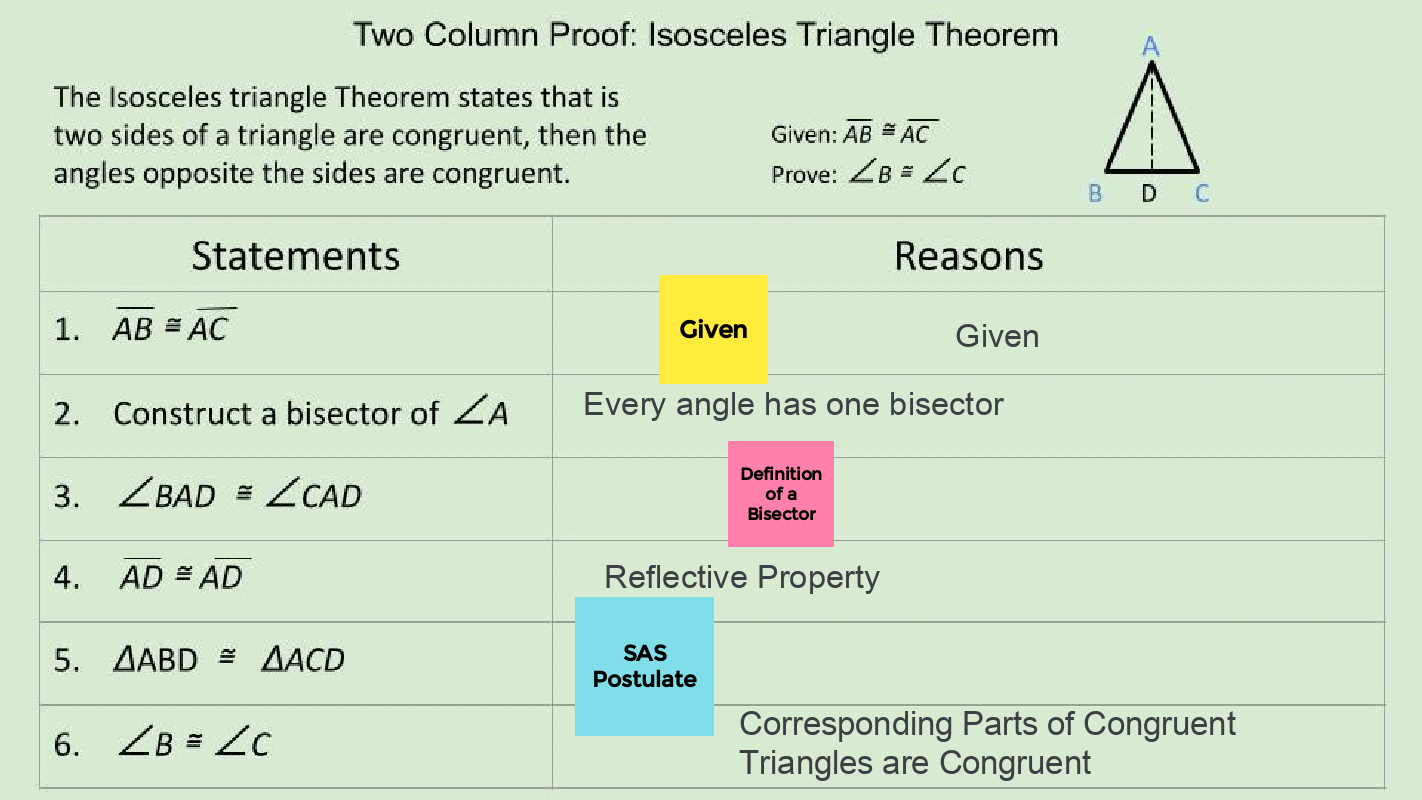
Here is an example of what it may look like once the students have done the activity

To access this Jamboard click here.

To make a copy of this Jamboard click here.

All Images by Chantal Hummel

Jamboard: Decimals and Base Ten Exit Ticket

Context: Exit Ticket
After 5th graders have a Math lesson on reviewing decimals (writing them, reading them, and making them using base ten blocks), the teacher can use a Jamboard Exit Ticket to check for student understanding.


Instructions for Students:
1.) Please open this Jamboard link.
2.) Click on the three dots at the top right of the page (next to the blue “Share” button).
3.) Click on “Make a copy.”
4.) Please answer all the questions.
5.) Once you’re finished, please click on the blue “Share” button and share it with the teacher’s email address before leaving class.

Use this hyperlink


Goal:
This Jamboard can help students meet the goal of understanding how to write, read, and make decimals using base ten blocks because it helps them check-in with their progress or understanding on achieving these goals.
Depending on which page(s) students get incorrect, the teacher can also use this data to guide instruction for the next Math class to make progress toward these goals.


Featured Imagephoto by Mika Baumeister on Unsplash

Reduce, Reuse, Recycle!

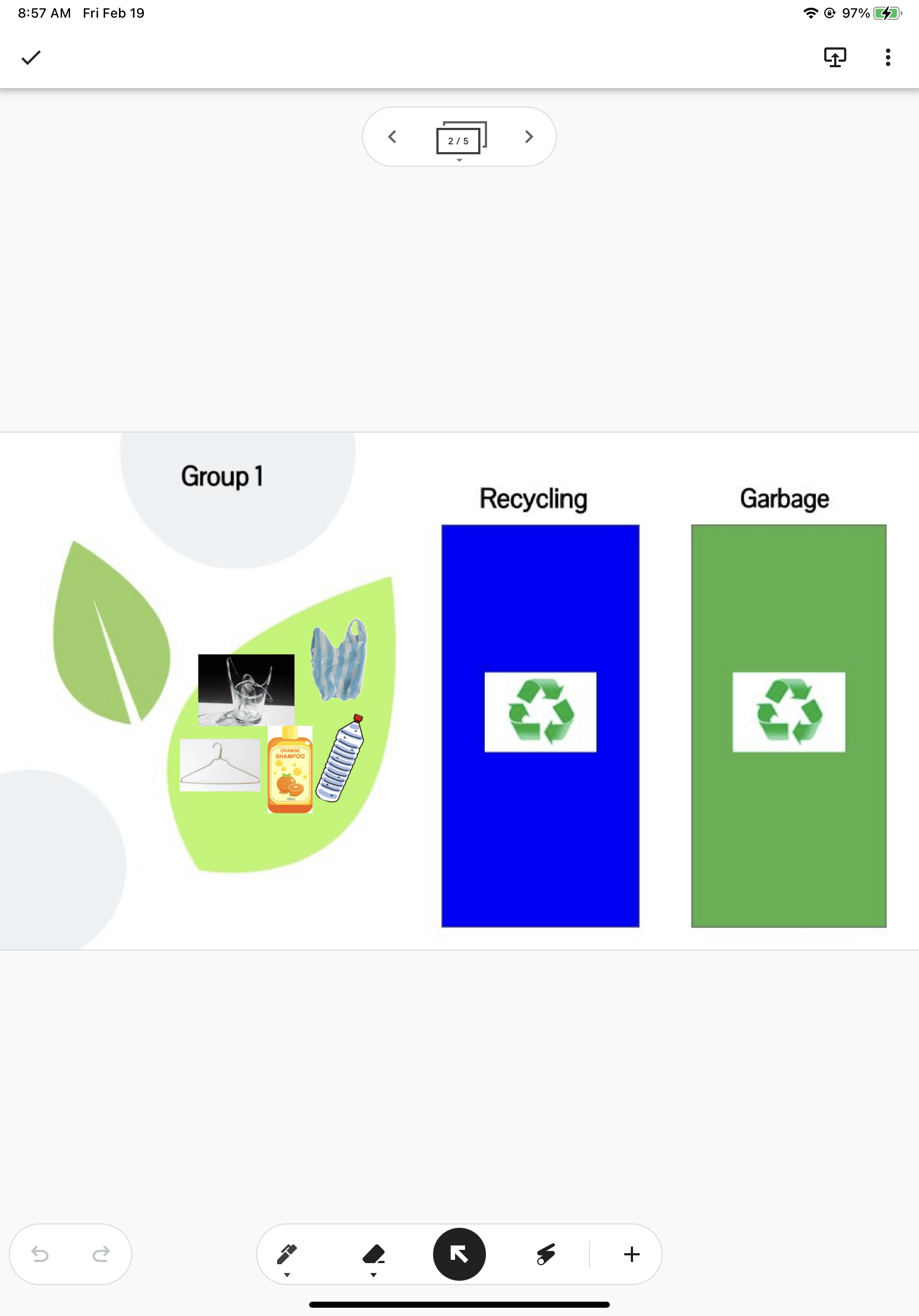
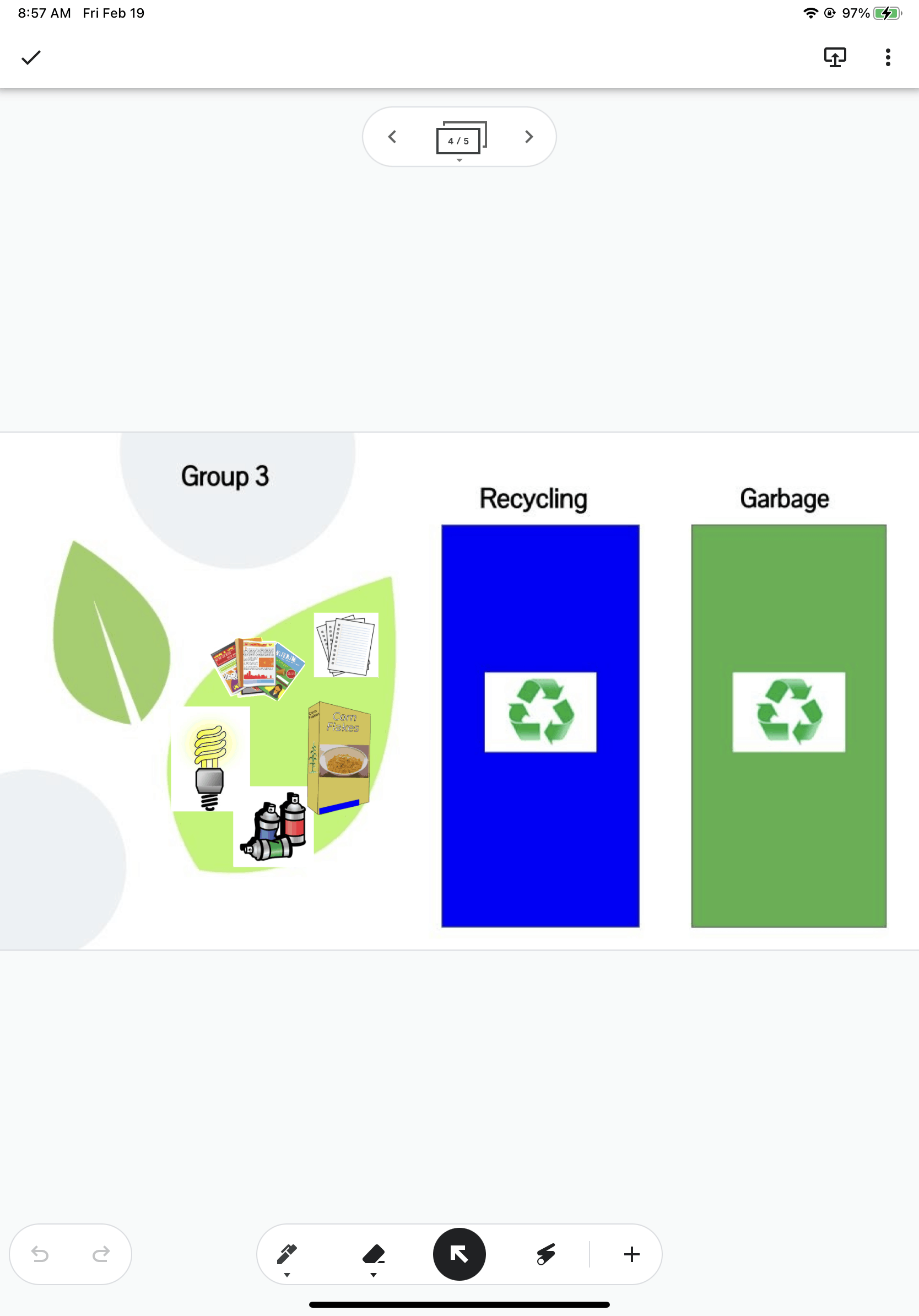
I would want to present this lesson either to a second or third grade class. The overall lesson would be to teach students what goes in the recycling and garbage bins and then eventually add on into the lesson later how certain items can be composted. This Jamboard would be used after teaching them about what is recyclable and what is supposed to go in the garbage. The activity would allow them to test their knowledge on information I just gave them as well as let me see what I need to go over again to make sure everyone understands

Instructions for Jamboard Activity

  1. After having a lesson on what can be recycled and what is garbage I will split the class into 4 groups
  2. Each group will have their own slide with 2 column saying garbage and recycling, there will also be a leaf where different items are seen
  3. Each group is to move each item to the column they think the item should be in (garbage or recycle?)
  4. I would give the students about 5 minutes with their group to do this activity and then as a class we would go through each groups slide to make sure they understand the lesson.

https://jamboard.google.com/d/1WDpRpRKjvH1wD-_LzIbY2xrVNXp3E3gglw3l4zsJVsU/copy

I hope to use this lesson in my own classroom in the future as well as Use Jamboard because I think its a great tool to use in the classroom whether its virtual or in person!

Featured Image: Photo by Paweł Czerwiński on Unsplash

La Nourriture : French Food Visual Dictionary

This is a lesson I will be doing with my seventh graders on Monday as the introduction to our unit on La Nourriture (food). I created a Jamboard with eight slides, containing eight categories of food: fruits, vegetables, meats, dairy, grains, desserts, meals, and drinks. Each slide has 8-10 vocabulary words in that category and students will be put into partners to work on one of the slides. They will look up the new words and recall prior knowledge/cognates to find images that represent each vocab word. This will create a visual dictionary for all of the students to access, rather than simply using a direct English-to-French translation format. When the partners are done, they will present their words to the class and teach each other the new terms (with me scaffolding pronunciation, answering questions, and adding cultural context).

The Periodic Table and the Atoms of the Universe

Featured image credit: “The Periodic Table, #58 on Explore 11/14/07” by larry wfu is licensed under CC BY-NC-ND 2.0

This is a very brief review intended for students who have been introduced to the basics of chemistry, especially in regards to the periodic table (probably for 6th grade and up). Students will:

  • Review what they already know about the periodic table
  • Reflect on information/concepts with which they struggle
  • Identify major families on the periodic table
  • Identify information represented by the periodic table
  • Recall information relating to atoms and subatomic particles
  • Use recalled information to identify parts of an atom
  • Practice collaboration skills by researching an element in groups (which will have to be assigned by an instructor)
  • Reflect on the value of the assignment itself

To view the Jamboard: Click HERE

The instructor will need to assign groups and (may need to) set or change time limits for each activity. Directions for each activity are included on each slide of the Jamboard.

This lesson allows students to actively engage with previously learned material and permits better and deeper understanding of the material learned through a variety of activities that appeal to the visual sense while learning and working with their peers.

Happy periodic learning!